
Warsaw is a city defined not by a single architectural era but by repeated reinvention. A meticulously reconstructed old town stands beside imperial avenues, socialist landmarks and a rapidly changing skyline. Parks occupy former royal grounds, contemporary museums tell difficult stories with confidence, and the Vistula riverfront gives summer evenings an easy, informal energy.
This Warsaw travel guide covers the historic center, essential museums, Praga, Polish food, parks, transport and a practical four-day itinerary. Three days suit the major sights; a fourth creates room for Wilanów, neighborhood exploration or a slower museum day.
Why Visit Warsaw?
Warsaw rewards travelers who engage with its history while noticing the living city around it. Nearly destroyed during the Second World War, the historic center was rebuilt using surviving fragments, paintings and archival plans. Its UNESCO status recognizes that extraordinary reconstruction rather than untouched medieval survival.
The capital also presents Polish history through outstanding institutions. POLIN explores a thousand years of Jewish life, the Warsaw Rising Museum examines the 1944 uprising, and the Chopin Museum connects music with personal objects and multimedia displays. Outside, café culture, riverside parks and ambitious restaurants show a young, creative metropolis.
Old Town and Castle Square
Begin at Castle Square early, before tour groups gather around Sigismund’s Column. The Royal Castle was destroyed during the war and later reconstructed, with recovered furnishings and works of art returned to its state rooms. Its interiors explain the Polish-Lithuanian Commonwealth, royal patronage and the Constitution of 3 May.
Walk through the narrow streets to Old Town Market Square, where colorful façades surround the Mermaid statue, Warsaw’s symbol. The arrangement looks historic because it follows earlier urban patterns, but details reveal the postwar rebuilding campaign. The Museum of Warsaw, spread across interconnected townhouses, is the best place to understand this layered story.
Continue to the Barbican and old walls, then explore quieter Kanonia and the Stone Steps. St John’s Archcathedral contains national tombs and a striking postwar interior. Return after dark, when the illuminated lanes feel calmer and less commercial.
The Royal Route
The Royal Route links Castle Square with former royal residences to the south. Krakowskie Przedmieście is lined with churches, palaces and the main campus of Warsaw University. The Presidential Palace and Hotel Bristol add political and social history, while benches along the route play fragments of Chopin’s music.
Nowy Świat continues toward the center with cafés, shops and restaurants. Side streets around Foksal and Chmielna provide quieter alternatives.
Farther south, the avenue leads toward Łazienki Park and ultimately Wilanów Palace. Walking the entire length is ambitious, so use a bus for the southern section and save energy for gardens.
POLIN Museum and Jewish Warsaw
POLIN Museum of the History of Polish Jews stands on the site of the former Warsaw Ghetto. Its core exhibition covers a millennium of Jewish life in Polish lands, presenting flourishing communities, cultural exchange, persecution and the Holocaust within a much longer history. The building’s flowing interior carries symbolic meaning of its own.
Allow at least three hours, use the audio guide if helpful and avoid scheduling another emotionally demanding museum immediately afterward. Opening days and free-admission arrangements change, so check the official site and reserve a timed entry during busy periods.
Outside, the Monument to the Ghetto Heroes faces the museum. A respectful walk through Muranów reveals memorial markers, fragments and the raised terrain created by wartime ruins. The neighborhood is residential; move quietly and avoid treating memorial sites as photo props.
Warsaw Rising Museum
The Warsaw Rising Museum focuses on the 1944 uprising against German occupation. Photographs, testimony, recreated environments and interactive displays communicate both resistance and catastrophic civilian consequences. It is immersive and can become crowded, so visit near opening and allow two to three hours.
The museum distinguishes the Warsaw Uprising from the earlier Warsaw Ghetto Uprising, events that are sometimes confused by visitors. Reading a short overview beforehand makes the dense chronology easier to follow.
Located in the former industrial district of Wola, the museum also fits a walk through modern office developments and surviving prewar structures. Take time afterward for a quiet meal or park rather than immediately entering another major exhibition.
Palace of Culture and Modern Warsaw
The Palace of Culture and Science, completed in the 1950s as a Soviet gift, remains Warsaw’s most divisive landmark. Its monumental tower dominates the center and contains theaters, cinemas, offices and an observation terrace. The viewpoint clarifies the city’s enormous scale and evolving skyline.
Around it, contemporary towers have transformed former railway and industrial land. Walk west toward Rondo Daszyńskiego for modern architecture or east toward central restaurants.
Check visibility before paying for the terrace.
Łazienki Park
Łazienki is Warsaw’s most elegant park, centered on the Palace on the Isle, classical pavilions and long tree-lined paths. Once a royal summer residence, the landscape now offers a peaceful counterpoint to museum-heavy days. Red squirrels and peacocks are common, but should not be fed.
The Chopin Monument hosts free outdoor recitals on scheduled summer Sundays, drawing large audiences. Arrive early with a picnic blanket and verify the current program. Outside concert times, the surrounding rose garden remains a pleasant stop.
Palace interiors and smaller buildings have separate opening arrangements, while the park itself is easy to explore freely. Combine Łazienki with the southern Royal Route or nearby Ujazdowski Park.
Wilanów Palace
Wilanów Palace survived the destruction that reshaped central Warsaw and preserves a Baroque royal residence surrounded by formal gardens. Its interiors, portraits and decorative arts provide a different perspective from the reconstructed Royal Castle.
Praga Across the Vistula
Praga, on the east bank, escaped some of the destruction suffered by central Warsaw and retains courtyards, brick factories and worn prewar buildings. The district has changed rapidly through galleries, restaurants and redevelopment, but visible inequality remains.
Start near the Praga Museum, then explore Ząbkowska Street and the Koneser complex, a former vodka factory adapted for culture and dining. Look into courtyards only where access is public and respect shrines maintained by residents.
Cross via metro or bridge, then return along the Vistula. The Praga bank has more natural shoreline, while landscaped boulevards on the western side provide cafés, cycle paths and seasonal events.
Vistula Boulevards
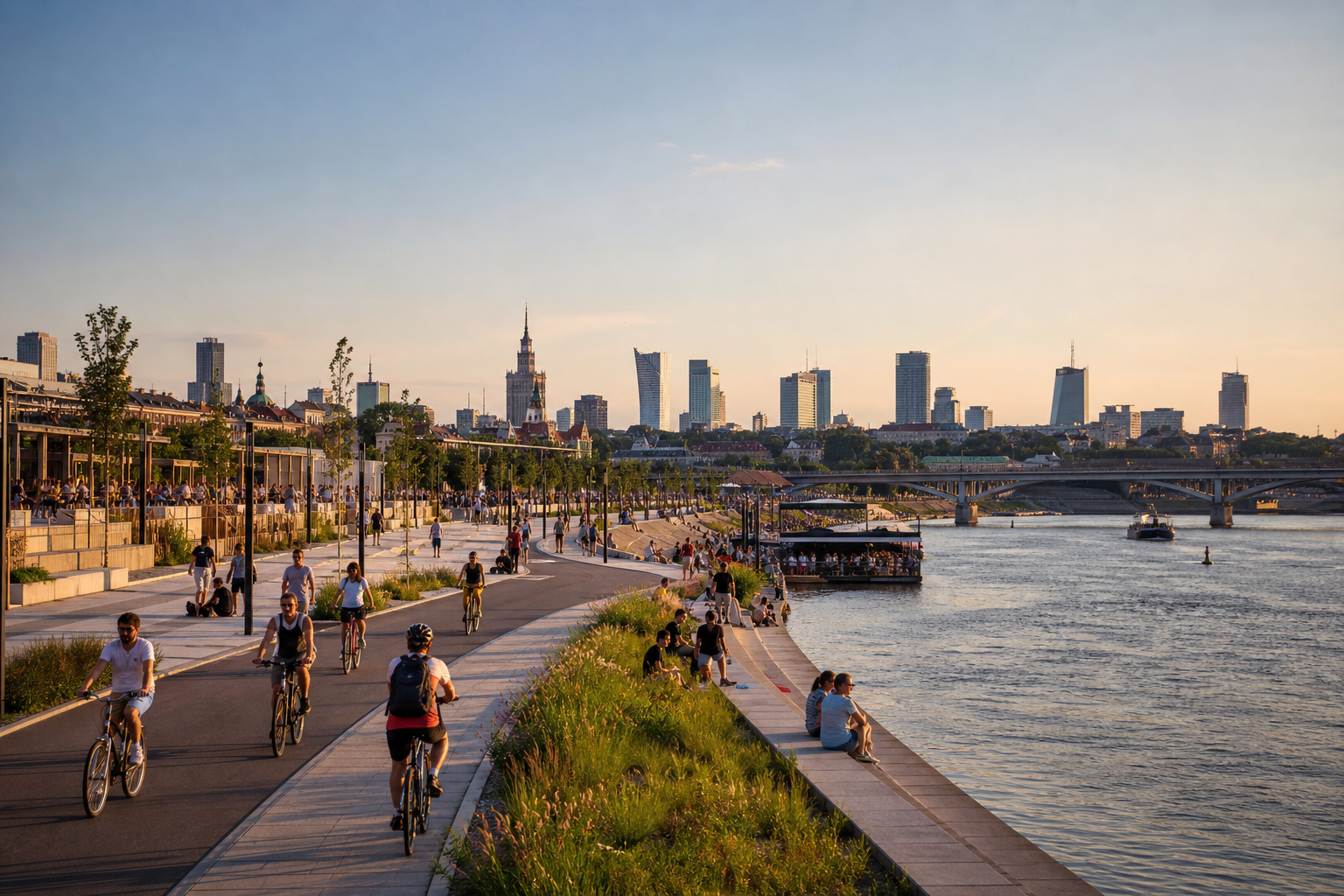
Warsaw’s riverfront becomes an important social space in warm weather. The western boulevards include steps, lawns, food stands and paths beneath bridges, while beaches and less-developed banks appear across the river. Sunset views toward the old town are especially attractive.
Cyclists and pedestrians share busy sections, so follow markings. Swimming in the Vistula is not recommended because of currents and navigation. Seasonal ferries may be free or included in public transport arrangements, but timetables and operation depend on water conditions.
The University of Warsaw Library garden combines rooftop planting with city views when open and links the Royal Route with the boulevards.
Polish Food in Warsaw
Pierogi come with fillings ranging from potato and cheese to meat, mushrooms or seasonal fruit. Other classics include żurek sour rye soup, bigos stew, potato pancakes and gołąbki cabbage rolls. Modern restaurants increasingly reinterpret these dishes with regional ingredients and lighter presentation.
Milk bars originated as subsidized canteens and remain valuable for inexpensive home-style meals. Service can be brisk and menus primarily Polish, but pointing and translation apps help. Clear your tray where requested and do not expect a leisurely restaurant experience.
Try pączki doughnuts and szarlotka apple cake. Hala Mirowska offers market atmosphere, while Hala Koszyki provides polished food-hall choices.
Getting Around Warsaw
Warsaw is far larger than the old center suggests. Metro, trams, buses and local trains use an integrated zone-and-time ticket system. Most visitor sights are in zone one, but verify boundaries and validate paper tickets immediately after boarding or entering the metro.
The official planner provides current routes. Short-term tickets suit occasional journeys, while day products can be better for Wilanów and Praga. Inspections are common.
Chopin Airport connects with the center by train and bus. Modlin Airport is much farther away, so confirm which airport is on your booking.
Best Time to Visit
May, June and September offer mild weather and active outdoor life. July and August can be hot, with festivals and busy riverfront evenings. Winter is cold and daylight short, but Christmas illumination and indoor culture create atmosphere.
Many museums close one weekday, often Monday or Tuesday, and some offer a weekly free day. Free admission attracts crowds, so the lowest price is not always the best experience.
Where to Stay
Śródmieście provides the easiest transport and broadest dining choice. The Old Town is atmospheric but quieter after restaurants close. Powiśle suits the river and university area, while Wola has modern hotels near the Rising Museum. Praga offers character but should be chosen street by street using recent reviews.
A Four-Day Warsaw Itinerary
On day one, explore Castle Square, the Royal Castle, Old Town and Museum of Warsaw. Walk the northern Royal Route after dinner.
Use day two for POLIN and a respectful Muranów walk, then visit the Palace of Culture viewpoint and dine in central Warsaw.
On day three, tour the Warsaw Rising Museum, relax in Łazienki Park and explore Nowy Świat in the evening.
Devote day four to Praga and the Vistula boulevards, or substitute Wilanów Palace. Add the Chopin Museum if music is a priority.
Final Tips for Warsaw
Reserve major museums, avoid stacking difficult historical exhibitions and wear comfortable shoes for long distances. Carry a payment card and some złoty, check ticket validation rules and learn basic Polish greetings.
Warsaw is most meaningful when reconstruction, memory and contemporary life are viewed together. Its beauty is not only in restored façades but in the confidence with which the city keeps changing. Give it time beyond the old town, and the capital becomes one of Europe’s most compelling urban stories.
Comments