
Riga is the largest Baltic capital and one of the region’s most architecturally varied cities. Medieval lanes gather around Gothic spires, elaborate Art Nouveau apartment houses line the central boulevards, and enormous market pavilions stand beside the broad Daugava River. Latvia’s capital feels both northern and eastern, shaped by German merchants, imperial Russia, occupations and restored independence.
Two days cover the Old Town, market and Art Nouveau district; three or four allow time for museums, neighbourhoods and the coast. This Riga travel guide explains the essential sights, food, transport and practical choices for a rewarding first visit.
Why Visit Riga?
Riga combines strong visual character with manageable scale. Its UNESCO-listed historical centre preserves more than eight centuries of urban history, while roughly 800 Art Nouveau buildings make the city one of Europe’s richest destinations for early twentieth-century architecture.
The city is also good value compared with many northern capitals. Central Market, riverside promenades, parks and varied museums provide plenty to do in every season. Contemporary restaurants reinterpret Latvian ingredients, and a growing creative scene occupies former industrial spaces beyond the medieval core.
Town Hall Square and the House of the Black Heads
Rātslaukums, or Town Hall Square, is a natural starting point. The ornate House of the Black Heads dominates the space with stepped gables and elaborate decoration. The original building, associated with a brotherhood of unmarried merchants, was destroyed during the Second World War and later reconstructed.
Its museum presents ceremonial rooms, silver collections and medieval cellars. Verify opening hours because events can restrict access. Nearby, Riga Town Hall and the Roland statue complete a square that feels historic but is substantially shaped by twentieth-century rebuilding.
Walk a short distance to the Occupation Museum of Latvia, whose exhibitions examine the Nazi and Soviet occupations from 1940 to 1991. The subject is emotionally difficult but essential for understanding modern Latvia. Allow time rather than squeezing the museum between lighter attractions.
Riga Cathedral and Dome Square
Dome Square is the Old Town’s largest open space, surrounded by buildings from several periods. Riga Cathedral began in the early thirteenth century and now combines Romanesque, Gothic, Baroque and later elements. Its great organ and acoustics make concerts especially appealing.
Entry arrangements vary between sightseeing, services and performances. Dress respectfully and check the programme ahead. The nearby Art Museum Riga Bourse occupies an opulent former exchange and displays international art in restored interiors.
From the square, follow Jauniela for colourful facades or wander toward the Three Brothers, Riga’s oldest group of residential houses. Narrow lanes reveal guild symbols, courtyards and fragments of the old defensive city.
St Peter’s Church and Old Town Views
St Peter’s Church has the tallest and most recognisable spire in the Old Town. A lift carries visitors to an observation platform with views over red roofs, Central Market, the Daugava and modern districts. Weather can close the tower, and queues form during cruise arrivals.
Afterward, explore nearby St John’s Church and the compact Konventa Sēta passages. The Great and Small Guild halls recall Riga’s Hanseatic merchant culture, while the Swedish Gate and surviving wall sections show how the medieval centre was defended.
Art Nouveau District
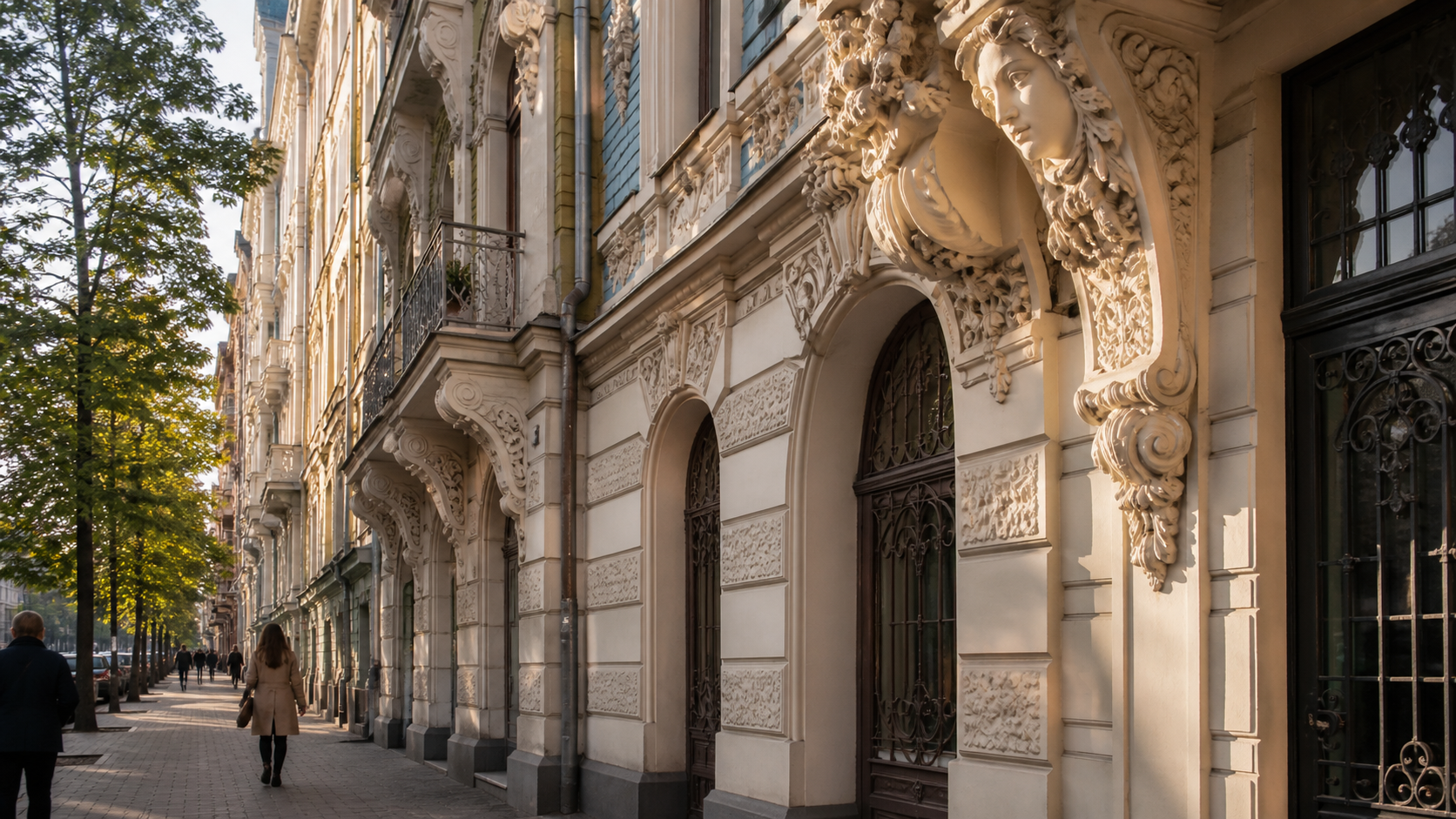
Riga’s Art Nouveau architecture extends across the central city, but Alberta iela, Elizabetes iela and the surrounding Quiet Centre contain the most concentrated display. Facades feature sculpted faces, mythological figures, floral ornament and geometric national-romantic forms.
Look upward and walk slowly. Architect Mikhail Eisenstein created some of the most theatrical buildings on Alberta Street, while Konstantīns Pēkšēns and Eižens Laube developed influential local approaches. Many buildings are private residences, so admire entrances without blocking them.
The Riga Art Nouveau Museum occupies Pēkšēns’s former apartment at Alberta iela 12. Restored rooms, furniture and domestic objects demonstrate how design extended beyond facades into everyday life. The building’s spiral staircase is itself a highlight. The museum normally closes on Mondays, but verify current hours.
The Central Market
Riga Central Market occupies five enormous pavilions adapted from German military airship hangars and opened in 1930. The complex remains a working market rather than a heritage display, selling fish, meat, dairy, vegetables, bread, pickles and household goods.
Visit in the morning when selection is strongest. Smoked fish, dark rye bread, local cheese, honey and seasonal berries provide easy tastes of Latvia. Ask before photographing vendors closely and keep belongings secure in crowded aisles. Some pavilions or stalls may close earlier than the official complex.
The surrounding outdoor market and nearby Spīķeri warehouse quarter extend the visit. Walk toward the Daugava promenade for river views.
Parks and the City Canal
The former defensive belt around Old Town was transformed into an elegant chain of parks. Bastejkalns, or Bastion Hill, rises beside the canal with winding paths, bridges and landscaped slopes. Boats operate seasonally along the canal and into the Daugava.
Continue through the park toward the Freedom Monument, Latvia’s principal symbol of independence. A female figure holds three stars representing the country’s historic regions. Guard ceremonies may take place, and political or commemorative gatherings occasionally affect access.
The Latvian National Opera stands nearby, while Esplanāde links the Orthodox Nativity Cathedral with the Latvian National Museum of Art.
Wooden Riga and the Left Bank
Across the Daugava, Āgenskalns contains restored wooden houses, quiet residential streets and its renovated market hall. The market combines local produce with cafés and casual food, offering a calmer alternative to the Central Market.
Kalnciema Quarter preserves nineteenth-century wooden architecture and hosts markets and cultural events, particularly on weekends. The National Library of Latvia, known as the Castle of Light, rises prominently on the left bank and has commanding river views.
What to Eat in Riga
Latvian cuisine reflects forests, farms, rivers and the Baltic Sea. Dark rye bread is central and appears with butter, cheese, smoked fish or in layered desserts. Try grey peas with bacon, potato dishes, sauerkraut, pork, beet soup and seasonal mushrooms.
Smoked sprats are commonly served on bread with egg or herbs. Sklandrausis is a small rye pastry filled with potato and carrot, associated especially with western Latvia. Rye-bread soup or rupjmaizes kārtojums layers crumbs with cream and berries for dessert.
Central Market is the best place to understand ingredients, while traditional restaurants present fuller dishes. Modern Latvian chefs use foraged herbs, birch sap, berries and fermentation with Nordic-style presentation. Explore beyond Old Town’s main squares for better value and more contemporary options.
Riga Black Balsam is an herbal liqueur with a strong, bittersweet flavour; try a small serving or cocktail. Latvian craft beer is widely available. Tap water is generally safe, and tipping around ten percent is appreciated for good table service.
Getting Around Riga
Old Town and the central boulevards are walkable, though cobbles demand supportive shoes. Rīgas satiksme operates buses, trolleybuses and trams. Electronic tickets must be validated on boarding, even when transferring under a time-based product.
Visitors can buy yellow e-tickets at machines, kiosks and authorised outlets, while mobile ticket options may also be available. Drivers generally do not provide the normal range of tickets. Check current fares and rules through the official operator before travel.
Riga International Airport lies southwest of the centre and is served by public bus, taxis and transfers. Use official taxi ranks or reputable apps. The central railway and coach stations sit beside the market, with connections across Latvia and the Baltic region.
Day Trips from Riga
Jūrmala offers a long Baltic beach, wooden villas and spa-town atmosphere about half an hour away by train. Stations serve different parts of the resort; Majori is the usual starting point. Buy the correct train ticket and expect cool water even in summer.
Sigulda and the Gauja National Park provide castles, forest trails and river-valley scenery. Travel is easiest by train or organised tour, but attractions spread across a wide area. Rundāle Palace is Latvia’s grand Baroque destination and usually requires a bus connection, car or tour.
Best Time to Visit
May through September brings long daylight, active terraces and the easiest conditions for architecture walks. June evenings are especially bright. July and August attract festivals and cruise visitors, yet weather remains variable.
December offers Christmas markets and atmospheric lights but very short days. January and February can be snowy, icy and intensely cold. Spring and autumn are quieter, with rain and reduced attraction hours. Pack layers, waterproof outerwear and shoes with grip in every season.
Where to Stay
Old Town offers atmosphere and easy sightseeing, but weekend noise and cobbles can be inconvenient. The central district between the parks and railway provides smoother transport access, Art Nouveau streets and a broader range of restaurants.
The Quiet Centre suits architecture lovers seeking elegant surroundings, while Āgenskalns provides a residential experience across the river. Check recent reviews for nightlife noise, lift access and heating or air conditioning according to season.
A Three-Day Riga Itinerary
On day one, explore Town Hall Square, Riga Cathedral, St Peter’s Church, the Three Brothers and remaining walls. Visit the Occupation Museum and walk the canal parks near sunset.
On day two, tour Alberta Street and the Art Nouveau Museum, then visit the Latvian National Museum of Art. Spend the evening in the central neighbourhoods beyond Old Town.
On day three, start at Central Market, continue through Spīķeri and cross the river for the National Library or Āgenskalns. Alternatively, take a train to Jūrmala for beach walks and wooden architecture.
Practical Tips
Latvia uses the euro, and cards are widely accepted. Carry some cash for market stalls. English is common in tourism, while Latvian greetings are appreciated.
Verify museum, church-tower and market hours shortly before visiting, especially on Mondays and holidays. Riga’s appeal comes from connecting its layers: medieval trade, extravagant Art Nouveau, difficult twentieth-century history and a modern Baltic culture that continues to reinvent the city.
Comments