
Nice combines the polish of a Riviera resort with the everyday energy of a real Mediterranean city. The Baie des Anges curves beside a palm-lined promenade, Old Nice compresses markets and Baroque churches into ochre-coloured lanes, and green hills provide viewpoints over sea and rooftops. Italian influence remains visible in the architecture, language and food, while Belle Époque hotels recall the European winter visitors who shaped the modern waterfront. This Nice travel guide covers the essential sights, local flavours, neighbourhoods and practical planning for a first Côte d’Azur stay.
Why Visit Nice?
Nice works as both a complete city break and a base for exploring the French Riviera. Museums celebrate artists drawn to the region’s light, trains reach coastal towns quickly, and the airport connects directly with the centre by tram. Yet there is no need to leave: beaches, markets, parks, restaurants and several distinct districts can fill three or four days.
Promenade des Anglais
The Promenade des Anglais follows the Baie des Anges for almost seven kilometres. Locals call it the Prom, and it functions as far more than a scenic road. Walkers, runners, cyclists and people resting on the famous blue chairs use it throughout the day. Begin early when the light is gentle and the waterfront feels spacious.
Architectural highlights include the pink-domed Hôtel Negresco and the Palais de la Méditerranée. Continue east past Jardin Albert I toward Quai des États-Unis, where the waterfront approaches Old Nice and Castle Hill. At sunset, the bay shifts through silver and deep blue while aircraft descend toward the airport in the distance.
Dedicated cycling space covers much of the route, but pay attention at crossings and busy pedestrian areas. The promenade is exposed to sun and wind, so carry water and protection even when the old town feels sheltered.
Nice’s Pebble Beaches
Nice’s beaches are made of smooth grey pebbles rather than sand. The water can become deep quickly, and waves make entering or leaving awkward. Lightweight water shoes improve comfort, while a padded mat is more useful than a thin towel. Observe flags and local safety advice because Mediterranean conditions can change rapidly.
Public beach sections are free and include showers in season. Private beach clubs rent loungers and umbrellas and usually operate restaurants. They provide convenience, not exclusive access to the sea, and prices vary considerably. For a simple experience, buy a picnic in Old Nice and choose a public section away from the busiest entrances.
Vieux Nice and Cours Saleya
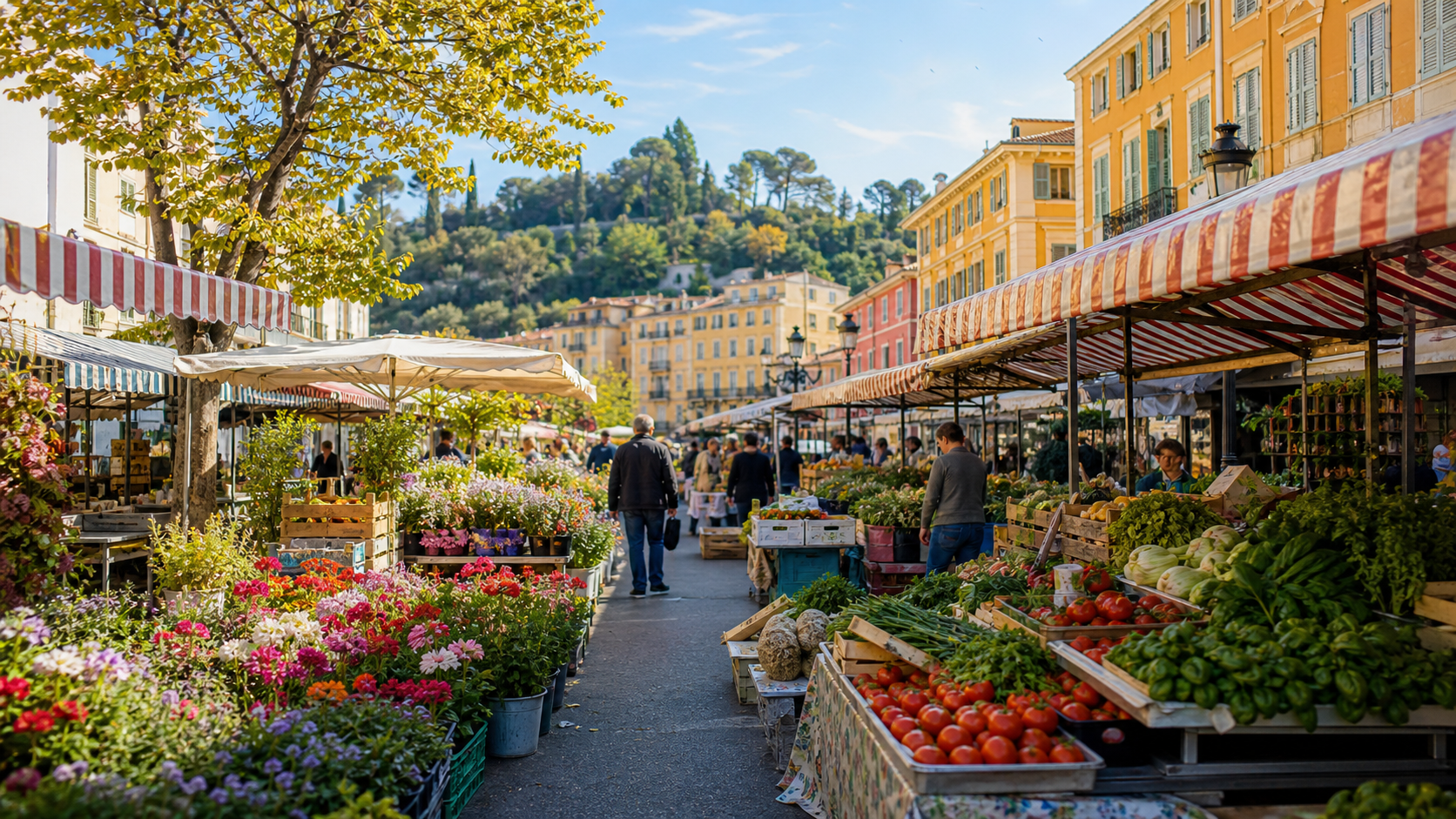
Vieux Nice is a dense network of narrow lanes between Castle Hill and the newer centre. Tall buildings in yellow, orange and red create shade, while ground floors contain food shops, bakeries, small restaurants and boutiques. Place Rossetti, dominated by Sainte-Réparate Cathedral, becomes especially lively around ice-cream shops and evening terraces.
Cours Saleya hosts the city’s best-known market. Depending on the day and season, stalls sell flowers, fruit, vegetables, olives, spices and local products; an antiques market replaces food vendors on certain days. Arrive in the morning for the full atmosphere and remember that schedules can change around holidays.
Beyond the main streets, look for Baroque interiors such as the Church of the Gesù and visit Palais Lascaris for historic rooms and musical instruments. Old Nice can feel crowded at midday, so explore early, rest later and return for dinner.
Castle Hill and the Best Views
Colline du Château rises between Old Nice and Port Lympia. The medieval castle has disappeared, but the park provides the city’s classic panorama over the curving bay, tiled roofs and promenade. On the opposite side, viewpoints overlook the port and Mont Boron.
Reach the summit by stairs, a winding road or the public lift when operating. The climb is manageable but hot in summer. At the top are shaded paths, ruins, play areas and an artificial waterfall. Visit in the morning for clearer light over the old town or in late afternoon, while allowing enough time to descend before gates close.
Place Masséna and Promenade du Paillon
Place Masséna connects Old Nice, the main shopping streets and the seafront. Its red façades, black-and-white paving and tram lines create one of the city’s most recognisable urban spaces. Avenue Jean Médecin runs north from here toward the railway station with department stores and familiar brands.
Beside the square, Promenade du Paillon forms a green corridor with lawns, gardens, children’s structures and a large reflecting pool fitted with fountains and mist. It is an effective route between the old town and cultural district and a popular place for families to cool down.
Port Lympia and the Eastern Coast
Port Lympia sits east of Castle Hill, framed by colourful buildings and filled with fishing boats, yachts and ferries. Walk around the basin, browse antiques and design businesses on nearby streets, then stop in the lively area around Place du Pin for food or an aperitif.
Cimiez, Matisse and Roman Nice
Cimiez occupies a hill north of the centre and reveals another side of Nice. The neighbourhood contains elegant residences, olive groves, Roman archaeological remains and the Monastery of Cimiez with peaceful gardens. It feels removed from the busy waterfront despite a straightforward bus journey.
The Musée Matisse presents works and personal context connected with Henri Matisse, who lived in Nice for many years. Nearby archaeological sites preserve the remains of Roman Cemenelum. Check current opening hours and ticket arrangements, as museums often close one day each week. Combine the hill’s attractions rather than travelling up for a single brief stop.
Art Museums and Belle Époque Architecture
For architecture, wander west of the centre around the Musicians’ Quarter and Boulevard Victor Hugo. Belle Époque apartment blocks, former palaces and ornate façades recall Nice’s development as a prestigious winter destination. The Russian Orthodox Cathedral, with colourful domes and detailed decoration, is another important landmark; respectful dress and behaviour are required.
What to Eat in Nice
Niçoise cooking draws from Provence, Liguria and the Mediterranean. Socca, a thin chickpea-flour pancake cooked in a hot oven, is best eaten immediately with pepper. Pissaladière combines caramelised onions, anchovies and olives on bread-like dough. Pan bagnat packages tuna, vegetables, egg, anchovy and olive oil inside a round loaf for a substantial picnic.
Salade niçoise should showcase tomatoes, tuna or anchovies, eggs, olives and crisp vegetables rather than heavy additions. Other specialities include petits farcis, stuffed vegetables; daube niçoise, a slow-cooked beef stew; and tourte de blettes, a sweet or savoury chard tart. Look for restaurants carrying the Cuisine Nissarde label, which identifies establishments committed to recognised traditions.
Markets and bakeries make casual meals easy. Rosé from Provence suits the climate, but local Bellet wines offer a rarer connection to vineyards within Nice. Reserve popular dinner tables in summer and do not assume every old-town terrace offers equal quality.
Best Time to Visit
April to June and September to October generally provide warm days, manageable crowds and pleasant conditions for walking. Sea temperatures are usually most appealing from late spring into autumn. July and August bring hot weather, busy beaches and high prices, though the city remains lively late into the evening.
Winter is central to Nice’s identity. Days can be bright and mild, accommodation may cost less and museums are quieter, although rain and cool winds remain possible. Carnival makes February a special and busier period. Pack layers in every season because temperatures shift between sunny streets, shade and the waterfront.
Getting Around Nice
Central Nice is best explored on foot. Trams connect major districts, and Line 2 links both airport terminals with the city centre and Port Lympia. Tickets use a rechargeable system and must be validated according to current rules. Buses reach Cimiez, Mont Boron and surrounding communities.
Nice-Ville station provides frequent regional trains along the coast toward Antibes, Cannes, Monaco and Menton. Trains are often simpler than driving, particularly in summer traffic. A car is unnecessary for a city stay and parking is expensive. For regional journeys, check schedules before late evening and allow extra time during major events.
Where to Stay
Vieux Nice places markets, nightlife and the beach close by but can be noisy and difficult with luggage. The Carré d’Or west of Place Masséna offers central streets, hotels and easy promenade access. The Musicians’ Quarter is quieter and convenient for the main station.
Port Lympia suits visitors seeking restaurants and a neighbourhood atmosphere, while Cimiez offers calm at the cost of frequent transport. Properties directly on the seafront command high prices and traffic noise may accompany the view. Confirm air conditioning for summer, lift access in historic buildings and the exact distance from a tram stop.
A Three-Day Nice Itinerary
On day one, walk the Promenade des Anglais, explore Cours Saleya and Vieux Nice, then climb Castle Hill for panoramic views. Dine in the old town. On day two, visit Cimiez for the Matisse Museum, Roman remains and monastery gardens. Return through Place Masséna and spend late afternoon on the beach.
On day three, tour an art museum, walk around Port Lympia and continue toward the eastern coastal path. Alternatively, take a regional train to a nearby Riviera town. With another day, explore Mont Boron, visit more museums or enjoy the city at a deliberately slower pace.
Practical Tips
Bring water shoes for the beach, reserve important summer restaurants and start outdoor sightseeing early. Use official transport sources for fares, validate tickets and keep valuables secure in crowds. Respect swim warnings and avoid exposed rocks in rough seas.
Leave time for morning market shopping, an afternoon swim and an evening walk beside the bay. Everyday Mediterranean life gives Nice its lasting character.
Comments