
Alicante is best understood from above and then explored on foot. Santa Bárbara Castle crowns Mount Benacantil, while the compact old town spreads between its slopes, the marina and the palm-lined Explanada de España. Together they tell a story that reaches from ancient settlement and medieval conflict to modern Mediterranean life.
This walking guide links the fortress with the historic streets below. It explains how to reach the summit, what to notice inside the castle, where to pause in Barrio de Santa Cruz and how to finish near the waterfront. Allow at least half a day, wear shoes with grip and check current access arrangements before setting out, because routes and opening conditions can change.
Why Santa Bárbara Castle Matters
The fortress occupies one of the most strategic viewpoints on Spain’s southeastern coast. Mount Benacantil rises sharply beside the sea, giving defenders a clear view across Alicante Bay and the surrounding plain. Archaeological evidence connects the hill with earlier cultures, although much of the visible complex reflects Islamic and later Christian periods.
The castle’s Spanish name commemorates Saint Barbara. Christian forces took the stronghold on her feast day in 1248. Control later passed to the Crown of Aragon, and successive rulers altered the fortifications. Bombardment, war, neglect and restoration all left marks, creating a layered military landscape.
Choosing Your Route Up
The easiest approach for many visitors is the lift entrance near Postiguet Beach, reached through a tunnel from Avenida de Juan Bautista Lafora. Check official information before visiting, as maintenance or operational restrictions can affect access. The lift reduces the climb, but some uneven surfaces and changes of level remain inside the complex.
Public transport and taxis may reach designated areas near the upper approach, subject to current traffic controls. Walking is the most atmospheric option. Paths from the old town and Parque de la Ereta climb the hillside through terraces and viewpoints. The gradient is substantial, particularly in heat, and the descent can be slippery after rain.
An excellent plan is to ascend by lift or transport and walk down through Ereta Park and Santa Cruz. If you prefer to climb, start early, carry water and avoid the hottest part of a summer afternoon.
Exploring the Upper Castle
Begin at the highest enclosure, often associated with the medieval core. From its terraces, the shape of Alicante becomes clear: Postiguet curves below, the marina projects into the bay, and the city extends toward the long beaches and mountains beyond. On a clear morning, the light is excellent for photographs without the harsh contrast of midday.
Look beyond the panorama. Walls, gateways, cisterns and courtyards reveal how the summit functioned as a defensible community. Interpretive displays connect individual structures with changing military technology. Read the signs in sequence when possible.
Move slowly on stairs and ramparts. Some edges are exposed, polished surfaces may be slick, and shade is limited. Families should keep younger children close. The reward for an unhurried circuit is a series of distinct perspectives, from the bright waterfront to the dense roofs immediately below the mountain.
The Middle and Lower Enclosures
Descending through the fortress brings later defensive works and larger open areas into view. These spaces accommodated troops, supplies and artillery as warfare changed. Rather than searching for one famous room, pay attention to the relationship between levels: narrow passages control movement, walls follow the rock, and terraces command different sectors of the coast and city.
Temporary exhibitions or cultural events may occupy parts of the castle. Availability varies, so treat them as an addition rather than the foundation of your visit. Basic services and accessible routes can also change. Consult the official Alicante tourism or castle information on the day you go if lifts, mobility access or a specific exhibition are important.
Most travellers need 90 minutes to two hours inside. Keen photographers and history enthusiasts can spend longer. There is little benefit in rushing; the castle’s strongest experience is the gradual shift between architecture, rock and sky.
Descending Through Ereta Park
From the upper area, follow the signed pedestrian route toward Parque de la Ereta when open. The landscaped hillside creates a transition between the fortress and old town. Terraces frame views of the sea, white houses and blue-tiled church domes, while benches offer welcome pauses.
This descent is especially beautiful in late afternoon, but do not leave it so late that gates or paths are closing. Take the marked route and resist shortcuts across loose ground. The park is exposed to sun and wind; a hat and water remain useful even though the city appears only minutes away.
Barrio de Santa Cruz
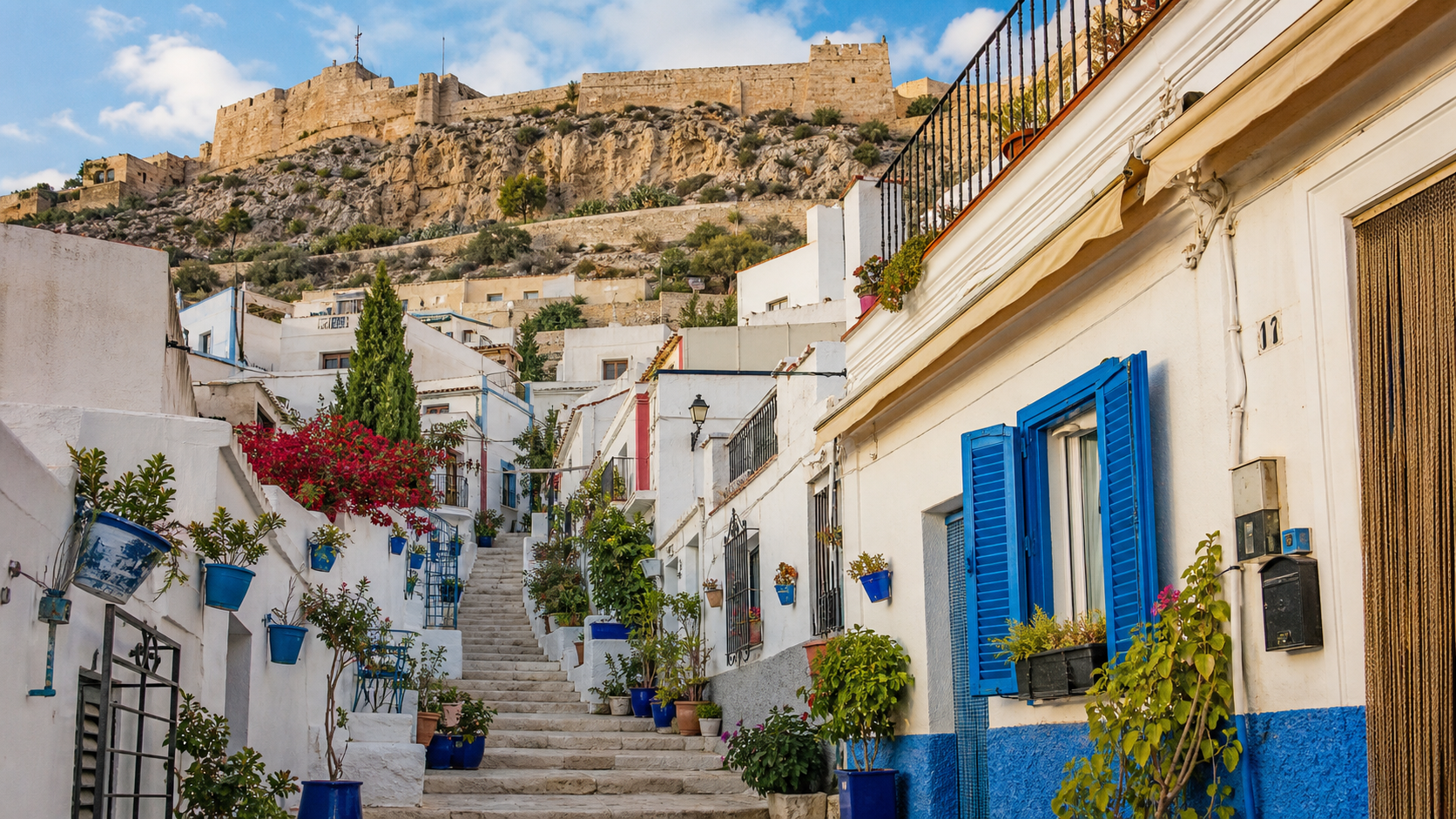
At the foot of the castle, Santa Cruz feels more like a village than a central-city neighbourhood. Whitewashed houses climb narrow lanes decorated with flowerpots, painted shutters and small religious tiles. Steps replace streets in several places, and sudden openings reveal rooftops, the cathedral and the Mediterranean.
The area is residential, not an outdoor film set. Keep voices low, avoid blocking doorways and ask before photographing people. Do not rearrange pots or enter stairways that appear private. Early morning offers quiet lanes, while evening creates a warmer atmosphere. Midday can be intensely bright and hot.
Wander gradually downhill, using the castle above and sea below as reference points. Calle San Rafael and the lanes around the Santa Cruz hermitage are particularly picturesque.
Basilica of Santa María
Continue toward the Basilica of Santa María, one of Alicante’s most important historic churches. It stands in the former medieval quarter on a site associated with the city’s main mosque after the Christian conquest. The exterior combines a robust Gothic character with later decorative elements, reflecting rebuilding and alteration over centuries.
Opening hours depend on worship and events. Dress respectfully, silence phones and never interrupt a service for sightseeing. Even when the interior cannot be visited, the stone façade and surrounding square make a worthwhile stop. Nearby cultural institutions can extend the historical theme if you have a full day.
Alicante Museum of Contemporary Art
The Museo de Arte Contemporáneo de Alicante, commonly called MACA, faces the basilica. Its collection and exhibitions provide a striking contrast with the medieval streets. Works connected with major twentieth-century Spanish and international artists place Alicante within a broader artistic story.
Check current hours and temporary closures before planning around the museum. A focused visit may take 45 to 75 minutes. It also offers a sensible indoor break during the hottest hours, allowing you to return to the walking route when the light is softer.
Calle Mayor and the Co-Cathedral
From Santa María, walk toward Calle Mayor and Plaza del Ayuntamiento. Alicante’s town hall presents an elegant Baroque façade, and the surrounding streets hold cafés, small shops and traces of the historic centre. Notice the official reference point for measuring altitude above sea level near the town hall steps, a modest detail many visitors pass without seeing.
Continue to the Co-Cathedral of San Nicolás. Its restrained exterior opens into a calm interior shaped by Renaissance and Baroque elements. The blue dome is a familiar part of Alicante’s skyline. As at Santa María, access revolves around religious use, so confirm visiting times and behave quietly.
A Break in the Old Town
This point in the route suits a late breakfast, lunch or tapas stop. Choose a place with a short, focused menu and look for local rice dishes, seafood, salted fish, seasonal vegetables and Alicante wines. Rice is central to the region’s food culture, but it is not necessarily a quick meal; many traditional preparations are cooked to order and intended for sharing.
Avoid selecting a restaurant solely from a heavily illustrated menu in the busiest square. Walk one or two streets away, compare recent menus and ask what is available that day. In Spain, lunch often begins later than visitors from northern Europe expect, while some kitchens close between services.
Finish at the Explanada and Waterfront
Descend through the centre toward the Explanada de España. Its wave-pattern mosaic, palm trees and café terraces create Alicante’s most recognisable promenade. After the enclosed lanes of the old town, the open view toward the marina feels dramatic.
Turn east to finish at Postiguet Beach, looking back at the castle from sea level. The summit that seemed distant in the morning now explains the whole route. Alternatively, walk west around the marina and watch boats return in the evening light.
Practical Planning
Spring and autumn usually provide the most comfortable walking conditions. Summer visitors should begin early, schedule indoor stops around midday and use sunscreen even when clouds soften the light. Winter can be mild, but wind on the summit is stronger than in sheltered streets.
Bring water, sun protection and secure footwear. Large luggage is unsuitable, and rules concerning bags, pets, bicycles or restricted areas may change. Check official notices for current opening hours, closures and accessibility information. Admission policies can also change, so verify rather than relying on an old blog post.
Allow four to five hours for the complete route, including the castle, Santa Cruz, two churches and a café break. Add the contemporary art museum and lunch for a relaxed full day. Travellers with limited mobility can enjoy substantial parts of the experience by combining the lift or vehicle access with the flatter streets around the town hall and waterfront.
Santa Bárbara Castle and Alicante Old Town work best as one continuous story. The summit explains why the city developed here; the hillside lanes show how residents adapted to the terrain; and the waterfront reveals modern Alicante’s relationship with the Mediterranean. Walk thoughtfully, leave time for views and let the route unfold from fortress walls to palm-lined sea.
Comments