
Sofia is one of Europe’s oldest capitals, yet it rarely presents its history in a neat sequence. Roman streets appear beneath metro stations, an early Christian rotunda sits inside a government courtyard, Ottoman and Orthodox landmarks stand minutes apart, and socialist-era buildings frame fashionable cafés. Behind everything rises Vitosha Mountain, giving the Bulgarian capital a dramatic natural horizon.
Two days cover the central landmarks; three allow time for Boyana Church or Vitosha. This guide explains the essential sights, food and practical choices for a first visit.
Why Visit Sofia?
Sofia combines remarkable historical depth with excellent value. The compact centre includes Roman archaeology, religious architecture, galleries, parks and lively dining within walking distance. Public transport is efficient, costs are moderate compared with many European capitals and English is common in visitor-facing businesses.
Alexander Nevsky Cathedral
The gold-domed Alexander Nevsky Cathedral is Sofia’s principal landmark. Built in the early twentieth century as a memorial connected with Bulgaria’s liberation from Ottoman rule, the vast Orthodox cathedral combines Byzantine-inspired forms, marble, mosaics and a shadowy interior filled with icons.
Visit in the morning when the square is quieter and light catches the domes. Entry arrangements, photography permissions and service times can change, so observe posted rules. Orthodox churches remain active places of worship: dress respectfully, speak quietly and avoid interrupting ceremonies.
The crypt houses an important collection of Bulgarian icons and requires separate admission. Nearby, Square 500 brings together Bulgarian and international art.
Saint Sofia Basilica and the Yellow Brick Road
Across the square, the red-brick Saint Sofia Basilica is more austere and considerably older. The city eventually took its name from this church, dedicated to Holy Wisdom. Beneath it lies an archaeological level containing tombs and remains from the ancient necropolis of Serdica. Check current access hours because the underground visit is separate from the main church.
Walk west along the famous yellow paving stones past the National Assembly, former royal palace and Russian Church of Saint Nicholas. Its gilded domes and compact garden create one of central Sofia’s most attractive scenes. The former palace now accommodates national art and ethnographic collections, though gallery arrangements can change.
Ancient Serdica and the Largo
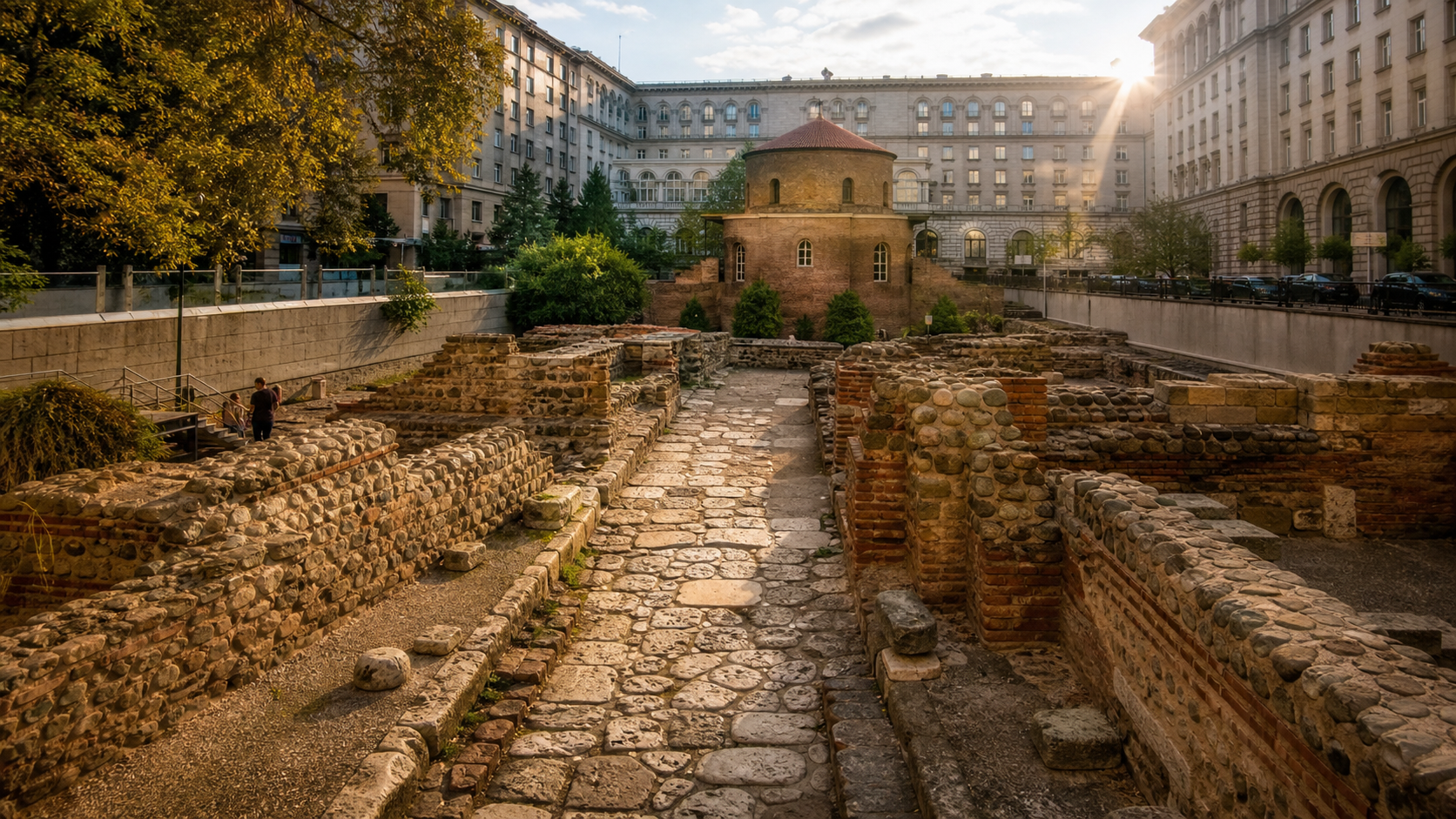
Sofia’s Roman predecessor, Serdica, flourished because of its strategic position and thermal springs. Archaeological remains are displayed around the Largo and Serdika metro station, where streets, house foundations and public buildings sit below boulevards.
Some areas are open-air and free, while covered sections may have specific hours. Information panels help, but a guided walk provides valuable context. The surrounding monumental buildings were constructed during the socialist period, creating an extraordinary visual dialogue between Roman ruins and twentieth-century state architecture.
The ornate former central mineral bathhouse contains the Regional History Museum, an excellent place to understand Sofia’s development.
Rotunda of Saint George
Hidden within the courtyard of the presidential complex, the fourth-century Rotunda of Saint George is among Sofia’s oldest surviving buildings. Its simple red-brick exterior contrasts with layers of medieval frescoes inside. Security around nearby government offices is visible, but public access to the courtyard is normally straightforward.
Services may take place in the tiny church, so enter quietly. Surrounding remains show how much history lies beneath the modern centre.
The Sofia Religious Triangle
Within a small central area stand Banya Bashi Mosque, Sofia Synagogue, the Orthodox Sveta Nedelya Church and the Catholic Cathedral of Saint Joseph. This proximity illustrates the city’s long religious diversity, sometimes called the Square or Triangle of Tolerance.
Banya Bashi Mosque dates from the Ottoman era and remains active. Visit only outside prayer times, remove shoes where directed and wear modest clothing. The Sofia Synagogue has controlled visitor access and security procedures; check hours and carry identification if required. Treat every site primarily as a place of worship rather than a photographic attraction.
Vitosha Boulevard and the National Palace of Culture
Pedestrian Vitosha Boulevard is Sofia’s main promenade, lined with shops, restaurants and cafés. On clear days, the street frames a direct view toward Vitosha Mountain. Prices here can be higher than on neighbouring streets, but the atmosphere is ideal for an evening walk.
Continue south to the National Palace of Culture, a monumental late-socialist complex used for events. Explore Shishman and Oborishte for independent cafés and dining.
Boyana Church
Boyana Church lies at the foot of Vitosha and is Sofia’s most important UNESCO-listed site. Its buildings date from several periods, while the celebrated frescoes of 1259 display extraordinary individuality and psychological detail. Because the interior is small and environmentally controlled, visits may be limited to short timed groups.
Reserve ahead when possible and confirm photography rules. The church combines well with the nearby National History Museum, housed in a former government residence, although seeing both requires several hours. Public transport reaches the district, but a taxi or organised tour can simplify the journey.
Vitosha Mountain
Few capitals have a mountain so close to the centre. Vitosha Nature Park offers hiking, forest walks, winter sports and broad views across the Sofia basin. Cherni Vrah, the highest summit, reaches 2,290 metres, so conditions can be significantly colder and windier than downtown.
Access routes, lifts and buses change with season and maintenance. Consult official information immediately before setting out and do not rely on old blog instructions. Choose a route appropriate to fitness, carry water and layers, and turn back if weather deteriorates. For a gentler excursion, explore lower trails near Boyana or Dragalevtsi.
Museums and Communist-Era History
The National Archaeological Museum occupies a former Ottoman mosque and contains Thracian, Roman and medieval treasures.
For twentieth-century context, the Museum of Socialist Art displays sculpture, paintings and propaganda from the communist period. Its outdoor collection includes monumental statues removed from public sites. The Red Flat, a private interpretive attraction, reconstructs aspects of everyday urban life in the 1980s. Consider the perspective and curatorial approach of each institution rather than treating any single exhibition as the complete story.
Borisova Garden and Neighbourhood Life
Borisova Garden is Sofia’s oldest major park, with wooded paths, sports facilities and lawns. It provides an easy break between museums.
Oborishte has elegant residential streets and cafés near the cathedral. Around Shishman Street, independent shops and restaurants create a lively atmosphere.
What to Eat in Sofia
Bulgarian food highlights vegetables, yogurt, white brined cheese, grilled meat and slow-cooked stews. Shopska salad combines tomatoes, cucumber, peppers and grated sirene cheese. Banitsa is flaky pastry layered with cheese and eggs, ideal for breakfast. Tarator, a cold yogurt and cucumber soup, is refreshing in summer.
Try kebapche or kyufte from the grill, kavarma meat stew, stuffed peppers and clay-pot gyuvech. Bulgarian yogurt appears in savoury and sweet dishes. Mekitsa is fried dough often eaten at breakfast, while baklava and other syrup pastries reflect Ottoman influence.
Traditional mehanas serve large menus in rustic surroundings, sometimes with folk music. Modern Sofia also has creative bistros, bakeries and strong vegetarian options. Rakia fruit brandy is potent and traditionally accompanied by salad; drink slowly. Bulgarian wines offer excellent value, especially local varieties such as Mavrud and Melnik.
Tap water is generally safe, and service charges are not always included. A tip around ten percent is appreciated when service is good. Check whether a restaurant accepts cards before ordering in smaller establishments.
Getting Around Sofia
Central Sofia is walkable, though paving can be uneven. Metro lines, trams, trolleybuses and buses cover the wider city. The metro connects Sofia Airport with central areas, making arrival straightforward. Buy the correct ticket or use approved contactless payment according to current system rules, and validate where required.
Transport inspections are common, so keep proof of payment until the journey ends. Day passes can be useful when visiting Boyana, museums outside the centre or distant neighbourhoods. Taxis are affordable by European standards but use licensed vehicles or reputable apps, and confirm that the meter is running.
Best Time to Visit
April through June and September through October provide comfortable walking weather, green parks and active terraces. July and August can be hot, but the city is quieter when residents travel. Mountain conditions remain cooler.
Winter brings cold temperatures, possible snow and skiing on Vitosha when conditions allow. Christmas markets and Orthodox celebrations add atmosphere. Air quality can deteriorate during stagnant winter weather, an important consideration for travellers with respiratory conditions.
Where to Stay
The area between Serdika, Alexander Nevsky Cathedral and Vitosha Boulevard is ideal for a first visit. Everything is walkable and metro access is strong. Oborishte offers a quieter, refined base near the cathedral, while neighbourhoods around the National Palace of Culture combine restaurants with convenient transport.
Accommodation near the central station is practical for early departures. Read recent reviews and confirm lift access in older buildings.
A Three-Day Sofia Itinerary
On day one, visit Alexander Nevsky Cathedral, Saint Sofia Basilica, the Russian Church and Ivan Vazov Theatre. Continue through the Rotunda, Largo and Serdica ruins before an evening on Vitosha Boulevard.
On day two, explore the Archaeological Museum, mineral baths and religious triangle. Spend the afternoon in Borisova Garden or the Museum of Socialist Art, then dine in the Shishman area.
Use day three for Boyana Church and the National History Museum, or devote suitable weather to Vitosha. Travellers staying in the centre can instead join a historical walk and explore more galleries and markets.
Practical Tips
Bulgaria uses the lev, although its currency arrangements may evolve; verify the current situation shortly before travel. Cards are common, but cash remains useful. Avoid unofficial exchange offices and compare displayed rates carefully.
Respect worship, dress modestly in religious buildings and ask before photographing interiors. Check opening hours, restoration notices and mountain transport before setting out. Sofia rewards patient exploration: beneath its busy streets lie whole cities of history, while the mountain beyond keeps the modern capital connected to nature.
Comments