
Antoni Gaudí changed Barcelona’s skyline with architecture that seems grown rather than constructed. Stone twists like fabric, roofs become landscapes and coloured mosaics turn ordinary surfaces into light. His buildings are among the city’s most popular attractions, but seeing them well requires more than moving from one famous facade to another.
Timed tickets sell out, several sites are expensive and the monuments spread across different neighbourhoods. This guide explains the essential Gaudí buildings, how much time each deserves and how to organise them without exhausting yourself. Two focused days cover the major works; a third allows quieter sites and deeper architectural context.
Understanding Gaudí’s Barcelona
Gaudí worked during the Catalan Modernisme movement, which combined new structural ideas, craftsmanship and references to Catalan identity. Nature provided models for columns, ventilation, light and decoration. His mature buildings integrate architecture, furniture, ironwork, ceramics and landscape rather than treating them as separate elements.
Barcelona contains works from different phases of his career. Comparing the relatively restrained Casa Vicens with the fluid Casa Batlló and the vast Sagrada Família reveals constant experimentation. Do not judge the interiors from exterior photographs: staircases, courtyards and roof structures often contain the most ingenious solutions.
Sagrada Família
The Basílica de la Sagrada Família is Gaudí’s defining project and Barcelona’s busiest monument. Construction began in 1882, and Gaudí devoted his later years to a building he knew future generations would complete. The Nativity and Passion facades present dramatically different sculptural languages, while the interior evokes a luminous forest.
Reserve an official timed ticket well in advance. Basic admission includes the basilica and museum; tower products add either the Nativity or Passion tower when operating. Tower visits involve lifts upward and stairs downward, may close because of weather and are unsuitable for some mobility conditions. The best overall experience does not depend on a tower.
Morning light tends to illuminate the cooler Nativity-side windows, while afternoon light intensifies warmer colours on the Passion side. Allow at least ninety minutes for the basilica, museum, school building and exterior. Dress respectfully because it is an active place of worship, and expect airport-style security.
Walk around the entire block before leaving. The Nativity facade, largely completed during Gaudí’s lifetime, is dense with natural and biblical imagery. The austere Passion facade was developed later according to the broader programme. Current construction changes viewpoints, so follow barriers and do not rely on an old entrance map.
Park Güell
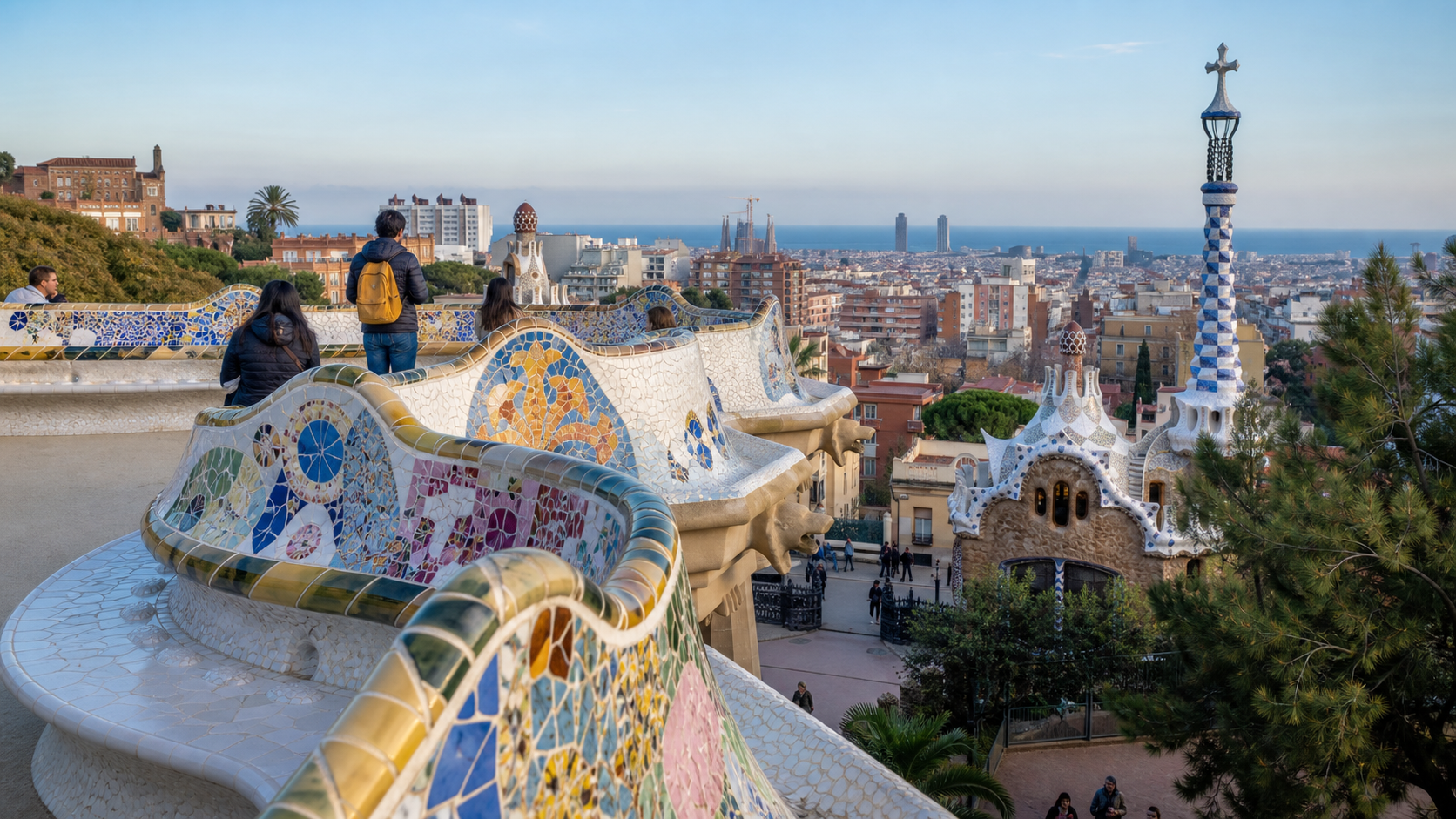
Park Güell began as a private residential development for entrepreneur Eusebi Güell, but the project failed commercially and became a public park. Gaudí adapted roads, viaducts and gathering spaces to a steep hillside. The famous mosaic bench curves around a terrace with broad views of Barcelona.
The monumental zone requires timed admission. Arrive early for cooler temperatures, softer light and fewer groups. Metro stations are not directly beside the entrance, and approaches involve slopes, escalators or buses. Check the official route from your accommodation rather than choosing the geographically closest station.
Allow about two hours for the monumental staircase, Hypostyle Room, terrace, viaducts and gardens. Gaudí’s former house now operates separately as a museum and may require another ticket. The park is not simply a collection of mosaic photo spots: notice how columns channel water, paths follow the terrain and stonework imitates geological forms.
Casa Batlló
Casa Batlló transforms an existing Eixample building into a theatrical composition of bone-like balconies, shimmering tiles and a roof often interpreted as a dragon’s back. Inside, a central light well grades from pale to deep blue so that daylight is distributed more evenly between floors.
Multiple ticket tiers offer different rooms, immersive displays and access conditions. Compare inclusions carefully; the lowest price may still provide the core architectural experience. The audio or augmented guide helps explain ventilation, joinery and symbolism that can be missed in crowded rooms.
Visit near opening or during a late slot. Passeig de Gràcia becomes extremely busy, and interior circulation is mostly one-way. Allow seventy-five to ninety minutes. Afterward, cross the avenue for a full facade view and observe neighbouring Modernista buildings in the “Block of Discord.”
La Pedrera–Casa Milà
Casa Milà, commonly called La Pedrera, appears more monumental and abstract than Casa Batlló. Its rippling stone facades wrap around airy courtyards, while an innovative structural system allowed flexible apartment plans. The rooftop turns chimneys, ventilation towers and stair enclosures into an extraordinary sculptural landscape.
The standard visit generally includes courtyards, an attic exhibition, a period apartment and roof. Wind or rain can restrict rooftop access, so choose a clear day when possible. The attic’s catenary arches provide one of the best explanations of Gaudí’s structural thinking.
If budget permits only one of the two Passeig de Gràcia houses, choose Casa Batlló for colour and fantasy or La Pedrera for structure, scale and rooftop drama. Seeing both is rewarding but mentally dense; separate them with lunch or visit on different days.
Casa Vicens
Casa Vicens in Gràcia was Gaudí’s first major residential commission. Its ceramic patterns, geometric volumes and influences from Islamic and Asian design feel different from his later organic work. The relatively compact house makes a useful introduction to his career.
Visitor numbers are usually lower than at the central icons, though advance booking remains wise. Allow about an hour and combine the visit with Gràcia’s squares and local streets. Look closely at the original ironwork, painted ceilings and relationship between garden motifs and interior decoration.
Palau Güell
Palau Güell stands close to La Rambla but receives fewer visitors than the Eixample houses. Built for Gaudí’s patron Eusebi Güell, the urban palace organises reception rooms, family spaces, service circulation and stables within a constrained site.
The central hall rises through several floors and was designed for both social events and religious use. In the basement, brick columns create a powerful former stable; on the roof, colourful chimneys anticipate later experiments. Allow sixty to ninety minutes and confirm weekly closing days.
Palau Güell is an excellent choice for travellers interested in architecture rather than only visual spectacle. It also provides a cooler indoor break during a day in the old city.
Torre Bellesguard
Torre Bellesguard occupies a quieter site in the foothills and blends medieval references with Gaudí’s structural imagination. The house recalls a royal residence that once stood here, using stone walls, battlements and a slender tower topped by a four-armed cross.
Access and tour formats are more limited than at major monuments, so verify the current timetable. Its distance from central routes makes it best for a second visit or a dedicated Gaudí day. In return, visitors gain space to examine details without constant crowds.
Colònia Güell and the Crypt
Outside central Barcelona, the crypt at Colònia Güell served as a laboratory for ideas later developed at Sagrada Família. Inclined columns, irregular vaults, stained glass and integrated furnishings create a compact but remarkably complete environment.
Reach the former industrial colony by FGC train and allow half a day for the crypt, workers’ settlement and exhibitions. Confirm train zones, opening hours and guided-visit options. Architecture enthusiasts often find this site more revealing than another crowded city-centre interior.
Lesser-Known Gaudí Details
Gaudí’s work appears beyond ticketed monuments. Lampposts in Plaça Reial are early commissions, while the gate and dragon at the Güell Pavilions demonstrate his ironwork and mythological references. Casa Calvet has a more conventional facade but inventive details.
The Teresian College and several private structures can generally be viewed only from outside. Respect school, religious and residential use. A facade walk is worthwhile, but never enter private courtyards without permission.
How to Plan a Two-Day Gaudí Itinerary
On day one, book Sagrada Família near opening. Continue to Recinte Modernista de Sant Pau for context from another architect, then travel to Park Güell in the afternoon. Finish in Gràcia and see Casa Vicens if energy and timing allow.
On day two, start at Casa Batlló, walk the Block of Discord and continue to La Pedrera. Take a long lunch before visiting Palau Güell in the old city. This arrangement groups sites geographically and prevents three highly detailed interiors from blending together.
For a third day, travel to Colònia Güell or Torre Bellesguard. Architecture specialists can add the Güell Pavilions and a guided Modernisme walk covering works by Lluís Domènech i Montaner and Josep Puig i Cadafalch.
Tickets, Timing and Practical Advice
Buy tickets from official monument websites and check refund conditions. Dynamic prices, temporary closures and restoration work can change the experience. Leave travel buffers between reservations; Barcelona traffic, queues and the uphill approach to Park Güell make tight schedules risky.
Most interiors involve stairs, dim rooms or narrow circulation, although accessibility provisions vary. Contact each site for current arrangements. Large luggage is inconvenient and may be prohibited. Carry water in warm weather, but follow rules about food and drinks inside.
Photography is usually allowed for personal use without flash, yet tripods and commercial equipment face restrictions. Be considerate in confined rooms and do not stop circulation for extended photo sessions.
Gaudí’s architecture is most rewarding when treated as design rather than decoration. Look at handles, airflow, changing daylight and structural curves as carefully as mosaics and facades. With thoughtful pacing, Barcelona becomes a connected study of one architect’s evolving ideas instead of a rushed sequence of famous buildings.
Comments