
Frankfurt is often treated as a gateway rather than a destination, yet Germany’s financial capital makes a rewarding city break. Its glass towers rise behind a reconstructed medieval center, first-rate museums line the River Main, and traditional apple-wine taverns survive a short walk from global banks. Neighborhood markets, botanical gardens and a diverse restaurant scene add depth beyond the skyline.
This Frankfurt travel guide covers the historic core, Museum Embankment, modern architecture, Sachsenhausen, local food, transport and a realistic three-day itinerary. Two days work for the highlights; a third allows time for Palmengarten, a specialist museum or a neighborhood beyond the center.
Why Visit Frankfurt?
Frankfurt’s contrasts are unusually visible. From the riverbank, Gothic cathedral stone, postwar reconstruction and some of Europe’s tallest office buildings occupy one panorama. The city is compact enough to explore on foot, but its U-Bahn, trams and S-Bahn make wider districts easy to reach.
Culture is a major reason to stay. The Städel spans seven centuries of European art, while nearby institutions focus on film, architecture, communication and world cultures. Frankfurt also has a strong literary identity through Johann Wolfgang von Goethe and a democratic legacy centered on St Paul’s Church. Add efficient airport access, and the city becomes an excellent first or final stop in Germany.
Römerberg and the New Old Town
Begin at Römerberg, the historic square framed by reconstructed half-timbered houses and the stepped façade of the Römer town hall. Much of central Frankfurt was destroyed during the Second World War, so the scene combines surviving elements with careful rebuilding. The square is most atmospheric early or after day-trip crowds fade.
Walk into the New Old Town between Römerberg and the cathedral. Completed in 2018, the quarter mixes exact reconstructions with contemporary buildings inspired by historic plots. Narrow lanes, small shops and courtyards restore an urban scale that had disappeared after the war. Interpret it as a modern conversation with history rather than an untouched medieval district.
Frankfurt Cathedral, or Kaiserdom St Bartholomäus, played an important role in imperial elections and coronations. When the tower is open, its stairs lead to a rewarding view across old roofs and skyscrapers. Check access and service times before climbing.
St Paul’s Church and Democratic History
Paulskirche stands just north of Römerberg and is closely associated with Germany’s first freely elected national parliament, which met here in 1848. The interior was rebuilt in a restrained form after wartime destruction and now serves primarily as a memorial and civic venue.
Exhibitions explain the development and limitations of the Frankfurt Parliament. Entry is generally straightforward, but official events can close the building. Even a short visit adds political context to the reconstructed old town and balances the imperial story of the cathedral.
Nearby, the Historical Museum explores Frankfurt’s development as a trading city, coronation center and modern metropolis. Its city models are particularly useful for understanding what survived, what vanished and how the present center was shaped.
Cross the Eiserner Steg
The iron Eiserner Steg footbridge connects the old town with Sachsenhausen and provides one of Frankfurt’s classic skyline perspectives. Pause near the center to look west toward the banking towers and east toward the cathedral. Sunrise and blue hour bring softer light than the middle of the day.
Both riverbanks are designed for walking and cycling. The northern promenade is convenient for the old town, while the southern bank links many Museumsufer institutions. In summer, lawns and waterside cafés become informal gathering spaces. Stay aware of marked cycle lanes, which can be busy at commuting times.
Museumsufer and the Städel
The Städel Museum is Frankfurt’s essential art collection, ranging from Old Masters to contemporary work. Highlights include German, Dutch, Italian and French painting, along with modern art displayed in a distinctive underground extension. Allow at least two and a half hours and consult the official site for current exhibitions.
Museum Embankment contains several other institutions within walking distance. The German Film Museum examines moving images and cinema technology; the German Architecture Museum explores the built environment; and Museum Angewandte Kunst focuses on design and decorative arts. The Museum of World Cultures presents rotating exhibitions rather than a single static route.
Choose one main museum and one smaller collection instead of attempting the entire bank. A Museumsufer ticket may provide value for a culture-heavy stay, but check current participating venues, validity and closing days before buying.
Main Tower and the Financial District
Main Tower’s public observation platform provides the clearest elevated view of Frankfurt. From approximately 200 meters above street level, the compactness of the center and the green hills beyond become apparent. Security screening is required, and the platform may close during poor weather, so verify conditions before going.
At street level, walk through the financial district toward the former Eurotower at Willy-Brandt-Platz. The newer European Central Bank headquarters stands farther east beside the preserved Grossmarkthalle.
Architecture enthusiasts should notice how towers meet older villas in the Westend. Public access to office buildings is limited, making Main Tower the dependable skyline experience.
Sachsenhausen and Apple Wine
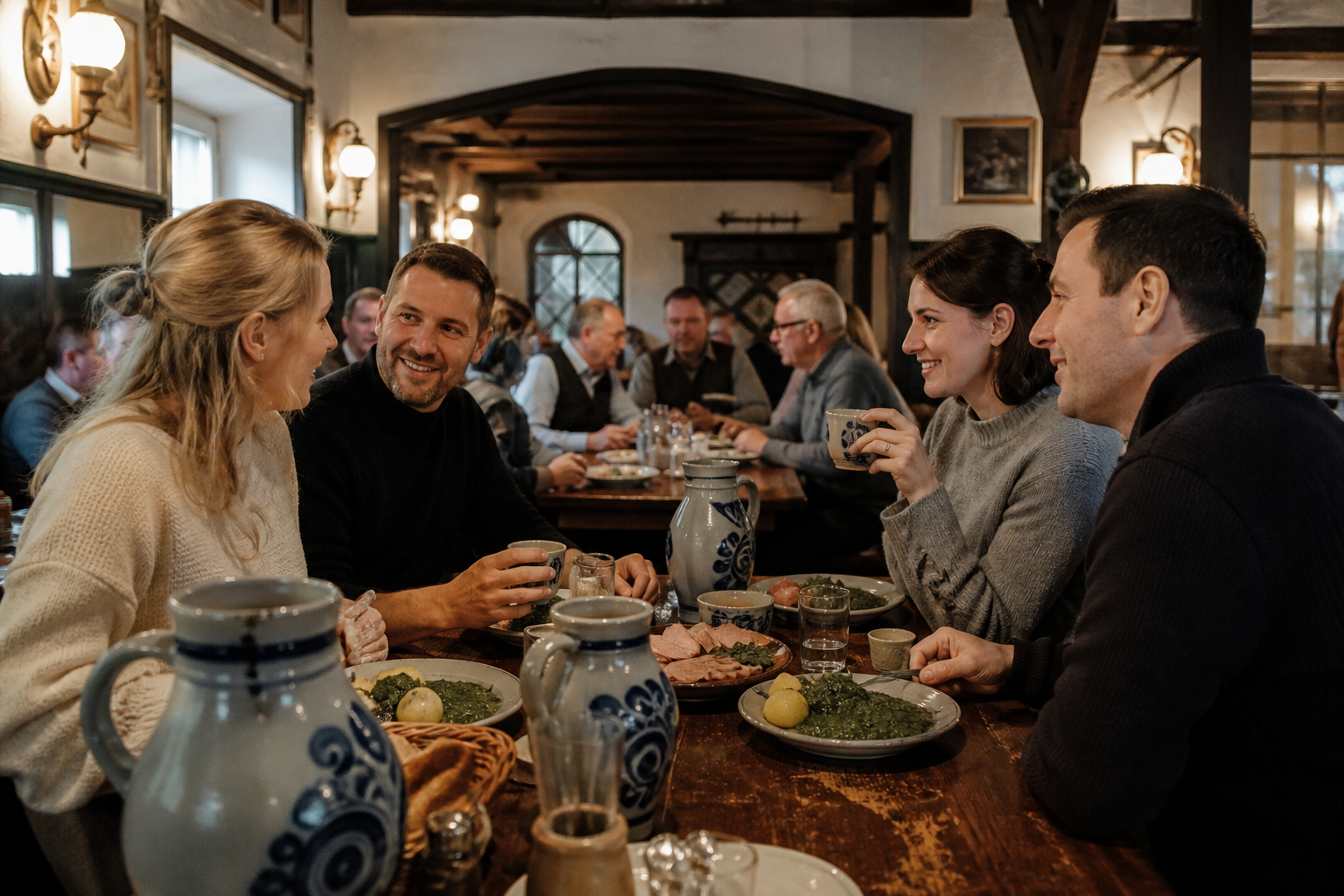
South of the Main, Sachsenhausen combines museum villas, residential streets and Frankfurt’s best-known apple-wine tradition. Alt-Sachsenhausen can become loud on weekend nights, while the Brückenviertel around Wallstrasse and nearby lanes offers independent shops, cafés and restaurants with a more relaxed atmosphere.
Traditional Apfelwein is tart, dry and lower in alcohol than many wines. It is served from a blue-grey ceramic jug called a Bembel into a ribbed glass. Ask for it pure or mixed with sparkling water if you prefer a softer introduction. Sharing tables is common in established taverns.
Order grüne Soße, Frankfurt’s herb sauce traditionally served with eggs and potatoes, or try Handkäs mit Musik, a pungent sour-milk cheese with onions and dressing. Frankfurter sausages, schnitzel and seasonal dishes complete the menu. Cash remains useful in traditional venues, and reservations help for groups.
Palmengarten and Green Frankfurt
Palmengarten is one of Germany’s major botanical gardens, with historic glasshouses, landscaped grounds and plants organized by climate. It offers a restorative half-day after museums and city streets. Seasonal displays change throughout the year, while tropical houses provide shelter in cold or rainy weather.
Nearby Grüneburgpark extends the green route, with lawns that suit a picnic in good weather. For a short trip, Palmengarten delivers the most concentrated introduction.
Neighborhoods Beyond the Center
Nordend is a favorite residential district, with leafy streets, cafés and shops along Oeder Weg and Berger Strasse. Continue east into Bornheim for markets and a lived-in neighborhood atmosphere. Both are pleasant choices for dinner away from business districts.
The Bahnhofsviertel is diverse and known for international restaurants. It also contains visible drug use and social challenges, so stay aware at night and choose accommodation using recent reviews.
Frankfurt Food Beyond Tradition
Frankfurt’s international population shapes an excellent dining scene. Turkish bakeries, Japanese restaurants, Eritrean kitchens and regional Chinese cooking sit alongside contemporary German bistros. The Bahnhofsviertel offers the greatest concentration, while Nordend and Bornheim suit a slower neighborhood evening.
Kleinmarkthalle is the central indoor market for produce, cheese, bread, prepared food and regional specialties. Visit before late afternoon and remember that Sunday trading is limited. The upper terrace is a popular place for lunch when open.
Getting Around Frankfurt
The old town, river and financial district are walkable. RMV integrates U-Bahn, S-Bahn, trams and buses across the region. Buy the correct fare zone before traveling and validate paper tickets where required. Day and group tickets may be economical, while the Frankfurt Card combines city transport with attraction discounts; compare current terms with your plans.
Regional and long-distance trains use Frankfurt Hauptbahnhof, while some services also stop at the airport or Südbahnhof. The main station is large, so allow time to find the correct platform.
S-Bahn and regional trains connect Frankfurt Airport with the central station in roughly a quarter-hour on many services. Confirm whether your train departs from the regional or long-distance airport station, which are separate but clearly signed.
Best Time to Visit
April through June and September through October offer comfortable walking weather. Summer brings riverbank life and festivals, along with occasional heat. December is atmospheric for the Christmas market around Römerberg, though accommodation can be expensive on popular weekends.
Trade fairs affect hotel availability throughout the year. Check the Messe calendar before choosing dates. Museums commonly close on Monday, and observation decks are weather-dependent, so keep the itinerary flexible.
Where to Stay
The Innenstadt and old-town edges suit first-time visitors who want to walk everywhere. Sachsenhausen offers evening character and museum access, while Westend is quieter and convenient for Palmengarten. Nordend feels residential, and the station district maximizes transport convenience but varies noticeably by street.
A Three-Day Frankfurt Itinerary
On day one, explore Römerberg, the New Old Town, cathedral and Paulskirche. Cross Eiserner Steg, walk the riverbank and spend the evening in a Sachsenhausen apple-wine tavern.
Devote day two to the Städel and one additional Museumsufer institution. Walk through the financial district and time Main Tower for late-afternoon light.
On day three, visit Palmengarten, browse Kleinmarkthalle and explore Nordend or Bornheim. Substitute the Goethe House or Höchst according to your interests.
Final Tips for Frankfurt
Do not judge Frankfurt only by the station approaches or airport connection. Reserve time for the river, a strong museum and a residential neighborhood. Carry some cash, check trade-fair dates and keep valuables secure in transport hubs.
Frankfurt works because its apparent contradictions are genuine: imperial history beside reconstructed streets, global finance beside communal tavern tables, and dense towers within reach of extensive green space. Stay long enough to cross the Main and the city becomes much more than a stopover.
Comments